
Psychedelics: The Coming Clinical Reckoning
Reading the Tea Leaves

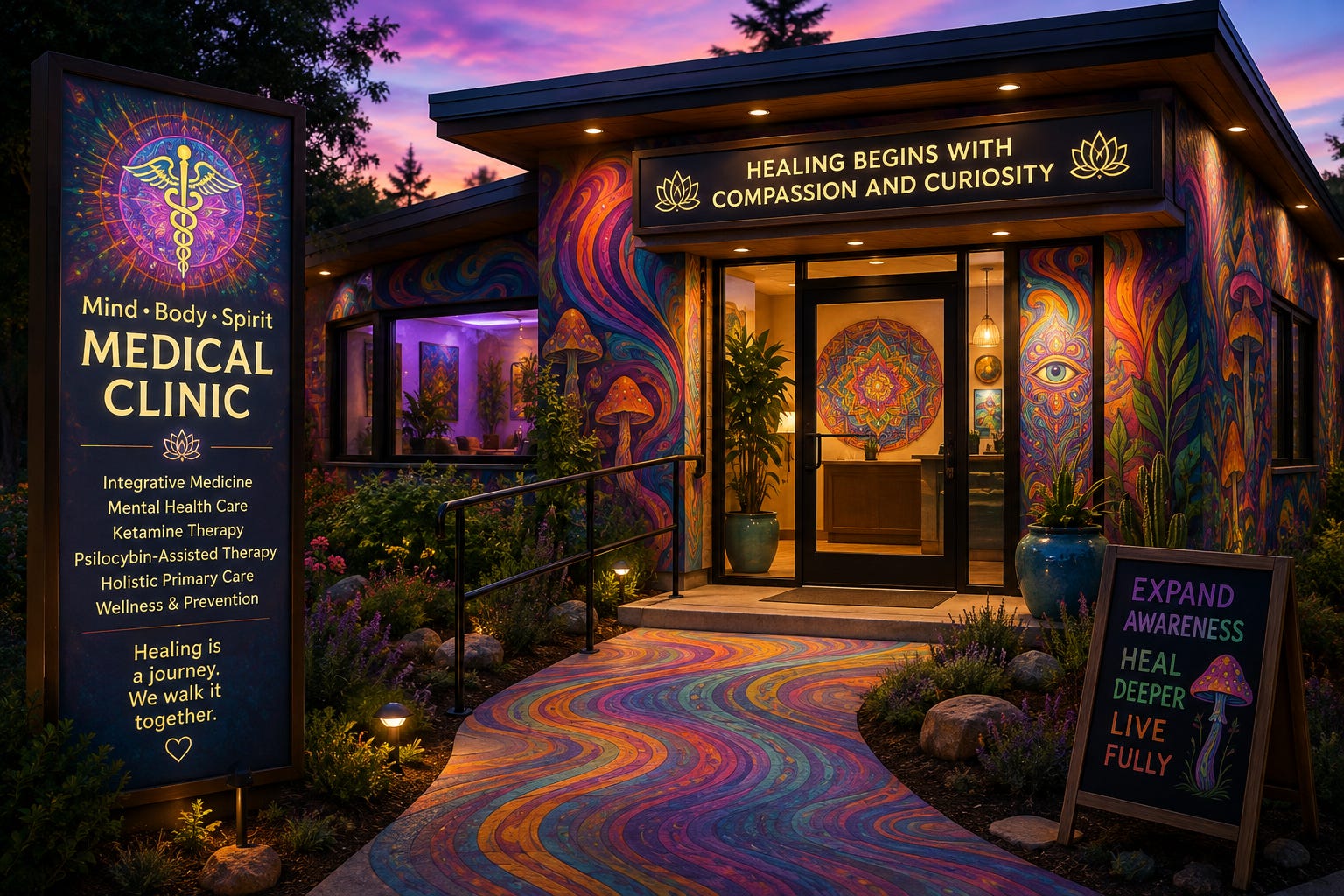
The most consequential emerging clinical story in behavioral health is arriving faster than most healthcare operations have recognized. I’m talking about psychedelics. What is coming is not just an expansion of retreats and wellness experiences, but clinical implementation.
Across the board timelines are being compressed. Compass Pathways has achieved two positive Phase 3 results for COMP360 (their synthetic psilocybin) in treatment-resistant depression. This was the first positive Phase 3 clinical trial data for any classic psychedelic in U.S. history. Compass is on track with their guidance of final NDA submission in Q4 2026 and launch in the first half of 2027. In April 2026, President Trump signed Executive Order 14401 directing federal agencies to accelerate psychedelic therapy review. The FDA followed a week later with National Priority Vouchers issued to Compass, Usona Institute, and Transcend Therapeutics. This collapsed the standard review window from 10-12 months to 1-2 months. Resilient Pharmaceuticals resubmitted its MDMA new drug applications (NDA) in August 2026 and Definium Therapeutics is not far behind with DT120, an LSD tablet with positive Phase 3 data in generalized anxiety disorder. In July the Health Resources and Services Administration (HRSA) issued a Request for Information (RFI) seeking stakeholder feedback on workforce training and care delivery models for the safe administration of potential future FDA-approved psychedelic therapies in ambulatory and community health settings.
In August 2025, AbbVie acquired Gilgamesh’s bretisilocin in a deal worth $1.2 billion. In July 2026th the Eli Lilly/AtaiBeckley psychedelic deal was announced to the tune of up to $3.8 billion. J&J’s esketamine (Spravato) generated $584M in Q2 2026 alone, up 40% year-over-year. The message is clear that big pharma sees the valuation potential in FDA approvals. The open questions now concern the ability of clinical and health systems to provide infrastructures for the delivery of these medicines.
Compass has announced two delivery collaborations with Radial and Osmind, the platform behind a national network of small-to-mid interventional psychiatry practices. They are on a hiring spree for jobs with a title of “Neuroscience Therapeutic Sales Specialist”. That is all you need to know. They are preparing for delivery that will happen in independent clinics, not health systems.
Top challenges to scale after FDA approval
DEA rescheduling: FDA approval doesn’t by itself make psilocybin prescribable. Schedule I placement has to be moved, and EO 14401 directs the Attorney General to expedite that review specifically because it’s a bottleneck.
Economics: This is the constraint everything else runs through. One or two clinicians occupying a room for 6–8 hours per patient is the least labor-efficient encounter in behavioral health. Nothing about credentialing or reimbursement matters if the financial math doesn’t work. Some of the faster acting psychedelics (DMT, 5-meo) could change the equation. Also, group treatment with the longer acting psychedelics like psilocybin and LSD could bring down the cost.
Reimbursement: Procedure codes for billing (CPT 0820T–0822T) are Category III meaning they are trackable, not payable. Category I conversion requires utilization data, which requires providers to bill unpaid codes first. Then CMS, then commercial payers. That sequence historically runs for years, and it starts after approval.
Credentialing standards: Thousands have been trained by CIIS, Columbia, IPI, MAPS, Fluence, etc. with no reciprocity, no common competency definition, and no licensure pathway. The likely resolution is that REMS (https://www.fda.gov/drugs/drug-safety-and-availability/risk-evaluation-and-mitigation-strategies-rems) becomes the de facto standard by default, which means the FDA sets the therapy workforce standard as a byproduct of drug safety regulation. Not obviously the right body for it.
Physical environment: A low-stimulation room tied up for most of a clinical day is space most behavioral health clinics don’t have and can’t repurpose without losing throughput.
Adverse events: Managing an acute psychological crisis with no psychiatric backup on site is unsolved, and one publicized incident in a clinic could reset the field’s trajectory.
Liability with no actuarial history: Carriers have almost no basis for pricing this. Informed consent boundaries for an altered-states intervention aren’t settled.
Current existing models
Spravato is the current closest structural model and the most useful. The process involves REMS-certified settings, two-hour post-dose observation, vitals before and after, and direct provider observation. It proved certified-site distribution works at scale and that payers will cover a monitored in-clinic psychiatric intervention. The problem is that a two-hour session versus six to eight is an enormous difference. Staffing ratios, room turns, and scheduling all break at that extended length.
Oregon is the cautionary case, and it’s the most instructive thing in the field right now. Of thirty-five approved service centers, twenty-two were still operating as of June 2026. Individual sessions range from$1,000 to over $5,000, group sessions at $300–$500, and multi-day packages up to $15,000. That spread is almost entirely labor and facility overhead. A roughly one-third closure rate in a cash-pay market with no reimbursement friction is the clearest available evidence that the session model doesn’t sustain itself on economics alone.
Colorado explicitly redesigned around Oregon’s failures. The design changes are the interesting parts including a micro-healing center tier with lower overhead, a prohibition on local government bans, and dual licensure for clinicians from launch. The micro-center tier (reduced security requirements, up to 750mg total psilocin on site) is a direct answer to the unit-economics problem and the closest thing to a template for a rural pathway.
Ketamine clinics are the operational predecessor nobody credits enough. They’ve been running prep–dose–integration, billing it, staffing it, and managing adverse events for years. Osmind’s network is largely these practices, which is exactly why Compass partnered with them.
The VA deserves a mention as they now have five sites in psilocybin trials, and roughly twenty psychedelic trials active system wide. It’s the one U.S. environment where the economics don’t bind which makes it a poor model for everyone else but a good proving ground for protocols.
The Road Ahead
So, what is it that we may see evolve?. My prediction is that psychedelic-assisted therapy is unlikely to integrate into general acute care in any near-term timeframe. The session model (preparation, 4-8 hours of supervised dosing, integration) is structurally incompatible with inpatient throughput economics and the existing acute care physical setting. What is more plausible is the possibility of the emergence of two tracks.
Track 1: Behavioral health specialty integration: Certified Community Behavioral Health Clinics (CCBHCs), outpatient psychiatric practices, and addiction treatment programs are the natural first-mover settings. CCBHCs receive enhanced Medicaid reimbursement and have the clinical staffing model to accommodate extended therapeutic sessions. The HRSA RFI specifically names CCBHCs as a target delivery setting.
Track 2: Health system-affiliated outpatient behavioral health: Major health systems that have invested in behavioral health ambulatory infrastructure will build or affiliate with psychedelic therapy clinics as a specialty line. This is a similar approach to how bariatric surgery centers and fertility clinics were launched. This is a 3-5 year horizon post-approval, conditional on CMS coverage and liability frameworks settling.
Time will tell how this all plays out and that time is coming soon. And what will become of the Underground? The Underground, as always, will morph to meet the needs and desires of a vast population not served by what the Overlords of approval and regulation decree.
Any thoughts on the part that might be played by organizations like mine – entheogenic churches?
Clinical reckoning precedes industrial capture