
Women in Psychedelics
His story became history.

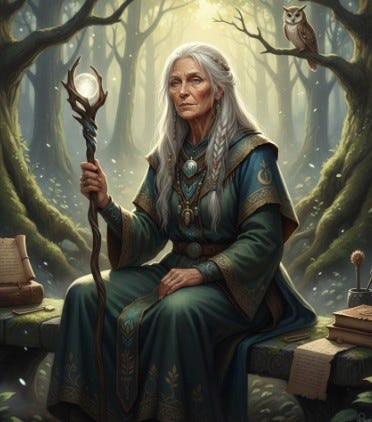
They burned the witches. The wizards got tenure.
Walk through any psychedelic conference or flip through the standard histories and you will find the same names recycled endlessly: Hofmann, Leary, McKenna, Shulgin. The authorized story unfolds as a procession of male discovery. We hear about the chemist who first synthesized it, the Harvard professor who distributed it, the ethnobotanist who catalogued it, and the underground pharmacologist who mapped its variations.
Women appear, if at all, as footnotes with asterisks. They are presented as wives, as muses, as unnamed participants in early clinical trials. They are the indigenous healers whose knowledge gets extracted, repackaged, and credited elsewhere. This isn’t oversight. It’s architecture.
The erasure operates through interlocking systems of patriarchy, colonialism, and academic gatekeeping that determine whose authority gets enshrined in the historical record. What we call psychedelic history is actually a highly curated artifact, assembled by and for a particular kind of protagonist.
Consider María Sabina, the Mazatec curandera whose sacred ceremonies had been transmitting mushroom knowledge for generations before R. Gordon Wasson showed up with his camera and translator. When Life magazine published his account in 1957, it positioned him as the discoverer, the brave Western explorer penetrating indigenous mystery. Sabina became a character in his story. She was exotic, authentic, and useful. The article brought tourists and seekers flooding into her village, destroying the secrecy that protected her practice. She died in poverty. Wasson got a second career.
The pattern repeats in therapeutic contexts. Ann Shulgin co-developed MDMA-assisted psychotherapy protocols and co-authored PiHKAL and TiHKAL, the massive texts that remain foundational to psychedelic pharmacology. Yet her contributions routinely collapse into her husband’s legacy. Alexander Shulgin is the chemist-shaman while Ann is the supportive wife who happened to be there.
Underneath the famous names lies a whole stratum of women whose work has been systematically downgraded from authorship to assistance. Leni Alberts in early mescaline research, Kay Parley and Gertrude Paltin in therapeutic settings. These were substantive creative and clinical contributions. Each appears now, if at all, as a minor mention referencing someone else’s breakthrough. There is no greater example of this than the story of Melissa Cargill. If she is known at all it is as the assistant to Owsley Stanley, widely recognized as the first underground chemist to manufacture mass quantities of potent LSD. But it was Melissa who had a background in chemistry from Berkeley and brought the lab techniques that made the operation successful and directly influenced the counterculture. And while we are talking about the 1960s, were there not women at Millbrook with Leary and Alpert? Why was their story omitted from the narrative?
Even when women lacked formal credentials, and they often did because institutions excluded them, they functioned as guides, confidantes, emotional anchors, and organizers. They held the social infrastructure that made male “genius” legible. Their labor was real. The credit wasn’t. This follows a familiar colonial logic. The anthropologist gets his name on the monograph and the indigenous informants get thanked in the preface. Collaboration gets reframed as hierarchy and shared work becomes singular achievement. The man with the institutional affiliation becomes the author while everyone else becomes his material.
Academic publishing and conference circuits amplify this dynamic brutally. Women’s case reports, memoirs, and community organizing work fall outside the archive of “serious” research. What gets preserved is what institutions recognize. What institutions recognize was shaped by who controlled them.
In psychedelic countercultures, the guru model reproduced the problem in a different manner. Male charismatic leaders dominated the public narrative, surrounded by women who were framed as lovers, muses, and followers, but not intellectual equals. Indigenous women, who had been transmitting plant medicine knowledge across generations, got invoked symbolically as the wise grandmother or the earth-mother healer. Meanwhile, they were structurally excluded from decision-making in contemporary psychedelic research, policy, and business.
The current “psychedelic renaissance” both repeats and contests these dynamics. Funding flows to Western institutions, biotech ventures, and clinical trials led overwhelmingly by men. The coin of the realm is still the double-blind placebo-controlled study, the peer-reviewed publication, and the venture-backed startup. These forms elevate certain kinds of knowledge holders and exclude others. Indigenous women’s expertise gets cited as legitimate but rarely compensated or centered in governance. However, something is shifting. There are more women in visible leadership roles. There is more explicit critique of the field’s colonial inheritances. More projects are attempting, however imperfectly, to redistribute authority and resources. Adding a few women to the existing pantheon will not cut it. The problem is not representation, it’s epistemology. It’s the underlying logic that treats some people’s experiences as data and others’ as anecdote. That calls one person’s vision “research” and another’s “folklore.”
Rewriting psychedelic history means recognizing women as co-authors of the knowledge, not supporting characters in someone else’s revelation. It means restructuring institutions so their authority isn’t exceptional, isn’t tokenized, isn’t erased in the next retelling.
The witches knew things. They always did. The question is whether we are finally ready to listen, or whether we’ll just burn them again and call it progress.
Excellent read.
So many women that were much more instrumental than history would let us know:
Christina Grof's foundational contribution to conceptualization and development of the now universally accepted principle of Spiritual Emergence/Spiritual Emergency
Kat Harrison (Terrence McKenna's ex, an ethnobotanist, dveoted to preserving traditional knowledge around medicinal plants)
Dobkin de Rios (Creativity research often subsumed under mantle of Oscar Janiger's work)
Allyson Grey (Alex's Grey's wife, an accomplished artist herself and co-creator of his theories about visionary art)
Swimming in the Sacred is about as close as it gets to any sort of credit to women's role in psychedelics but much of those women remain anonymous.
OK thanks for inspiring that response. And for the article.
Another one of these "wizards" just blocked me the other day for saying so. 👏🏾