
The Shaman's Path
The Mazatec and the Holy Psychedelic Trinity

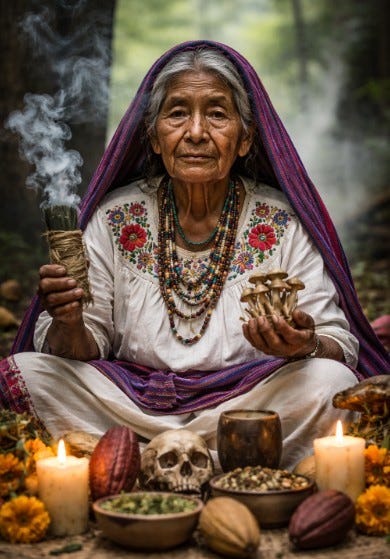
The Mazatec developed and still maintain a relationship with three sacred substances that reshape consciousness. Unlike the flamboyant evangelists of the 1960s, the Mazatec curanderos operated in silence, their knowledge passed down through generations in ceremonies that outsiders rarely witnessed. The most famous of these medicines are the mushrooms the Mazatec call nti si tho, “little ones that spring forth.” These weren’t recreational drugs or tools for self-exploration. They were spiritual technology, employed in healing ceremonies that predated the Conquest by centuries.
Less known but equally significant is ska María Pastora, what botanists would later classify as Salvia divinorum. “Leaves of the Shepherdess,” the Mazatec called it, and unlike the mushrooms, Salvia never achieved mainstream fame. Perhaps that’s because salvinorin A, the compound responsible for its effects, at high doses produces experiences too strange, too dissociative, too far removed from the pleasant visuals that Westerners expected from psychedelics. The Mazatec used it for divination, for finding lost objects, for communicating with the spirit world. It wasn’t about feeling good. It was about seeing clearly.
Then there are the seeds, ololiuqui, or badoh to the Mazatec. The morning glory seeds from Rivea corymbosa and Ipomoea violacea, contain LSA, lysergic acid amide, the chemical cousin of the substance that would define a generation. To the Mazatec, they were another tool in the pharmacopeia, producing effects similar to but gentler than what Albert Hofmann would accidentally discover in his Basel laboratory in 1943.
What’s striking isn’t just that these three substances exist, but that the Mazatec developed a sophisticated understanding of them long before the came to the attention of the modern world. They knew which plant for which purpose, which dosage for which ceremony, which intentions required which medicine. That knowledge continues to remain largely hidden, protected by the same silence that kept it alive for centuries.
María Sabina died in 1985, poor and disillusioned by what the West had done with her sacred mushrooms. The Mazatec traditions continue, though quieter now, more careful about who they let into the circle. The three medicines remain, as they always have, not as drugs but as doorways to be used by those who remember that some knowledge is meant to be whispered, not shouted, and that the most profound substances demand more than curiosity. They demand respect.
To become a chjota chijne, a Mazatec shaman, is not a career choice. It is a calling. A destiny. A lifelong spiritual commitment that begins not with ambition, but with selection.
The path rarely begins by choice. A person is identified as a potential shaman through various means: they might be born into a lineage of healers, like María Sabina, whose father and grandfather were shamans before her. They might survive a “shamanic illness” that others interpret as divine selection. Or they might have recurring, vivid dreams that elders recognize as a call from the Holy Children (mushrooms) or Ska María Pastora (Salvia). Some enter the path in childhood, participating in ceremonies to cleanse their vision before the distractions and coping mechanisms of adulthood set in.
What follows is a rigorous, years-long process of spiritual refinement, technical mastery, and self-discipline. The Mazatec will insist that shamans are taught not by people, but by a progression of visions from and of heaven. The psychotropic plants themselves are the true teachers. The human mentor is merely a facilitator.
The training is centered on asceticism and self-denial. A trainee must prove they have the discipline to handle the power of the plants. There is a very rigid diet (la dieta) to follow. Garlic and chili peppers are restricted. Salt is avoided. Alcohol is forbidden. Sexual abstinence is considered a critical rule. Mazatec tradition holds that the spirit of Salvia is extremely jealous and pure; any sexual activity during training or before a ceremony is believed to cause madness or turn the medicine into a poison. Breaking from the dieta can make one crazy, according to oral tradition and since such obligations require maturity, one should be at least 30 years old before becoming a curandero.
Trainees spend long periods in total darkness and silence, learning to listen to the plants. The Mazatec say that Salvia speaks with a quiet voice, and one must be silent to hear her instructions.
In the mountains of Oaxaca, vision inducers are taken systematically at intervals of a week to a month. The process begins by taking successively increasing doses of Salvia divinorum to become acquainted with the “way to Heaven.” Next comes mastery of the morning glory seeds. Finally, one learns to use the sacred mushrooms, the Holy Children. This progression can last two years or longer.
The apprentice learns to arrange the ritual table which serves as a spiritual map and often includes candles, copal incense, flowers, and images of Catholic saints. They must learn to identify and handle the sacred plants. But more importantly, they learn to maintain presence while in deep trance states. Apprentices are sometimes given a high dose of psilocybin mushrooms and instructed to sit perfectly still before the altar. The goal is to keep the eyes open and the mind clear, using the altar as an anchor. This teaches the shaman to navigate the landscapes of the spirit world without becoming overwhelmed by the visions. They learn to look the monster in the eye and to confront frightening visions to gain wisdom or retrieve a patient’s lost soul.
A shaman’s primary tool is not just the plant, but their voice. During ceremonies, the shaman enters a trance and begins a rhythmic, melodic chant. Trainees learn a specific ritual language that is different from everyday Mazatec. It is a poetic, improvisational flow of words that calls the spirits of mountains, saints, and ancestors. The chanting acts as a kind of lighthouse. The shaman uses their voice to guide the patient through the visions, ensuring they don’t get lost in the “zipper” or “folding” dimensions of the Salvia experience.
In higher-level initiations, the trainee takes a heroic dose of the plant in total darkness. They are expected to receive a “visionary book” in their mind, which grants them the authority to heal. Part of the training involves using the plant to see inside a patient’s body or to locate a lost soul. The initiate must practice diagnosing illnesses while under the influence of the medicine.
There is no graduation ceremony. A person becomes a recognized chjota chijne when they can successfully diagnose illnesses, find lost objects, and facilitate healing for others. Mastery is a lifelong commitment to serving the community and maintaining the relationship with the spirit world and the plant teachers.
Once someone becomes a healer, the hallucinogenic plants are ingested much less frequently than during training. The shaman’s role implies a lifelong commitment to serving both humanity and the divine.
It’s worth noting that many Mazatec shamans incorporate alcohol into their training and drink during their ceremonies, showing some variation in practice. The secretive nature of Mazatec shamanism makes it difficult to gather comprehensive information, as shamans tend to be protective of their practices and knowledge. But what remains clear is this: the path of the chjota chijne is not learned from books or classes. It is lived. It is endured. And it is never truly finished.
Brilliant. It's so insightful to frame these ancient Mazatec practices as a form of 'spiritual technology' rather than just a historical curiosty. It really makes you think about how different cultures essentially develop varied 'operating systems' for interpreting realilty and consciousness.