
The Psychedelic Countess
Amanda Feilding and the long game of psychedelic science

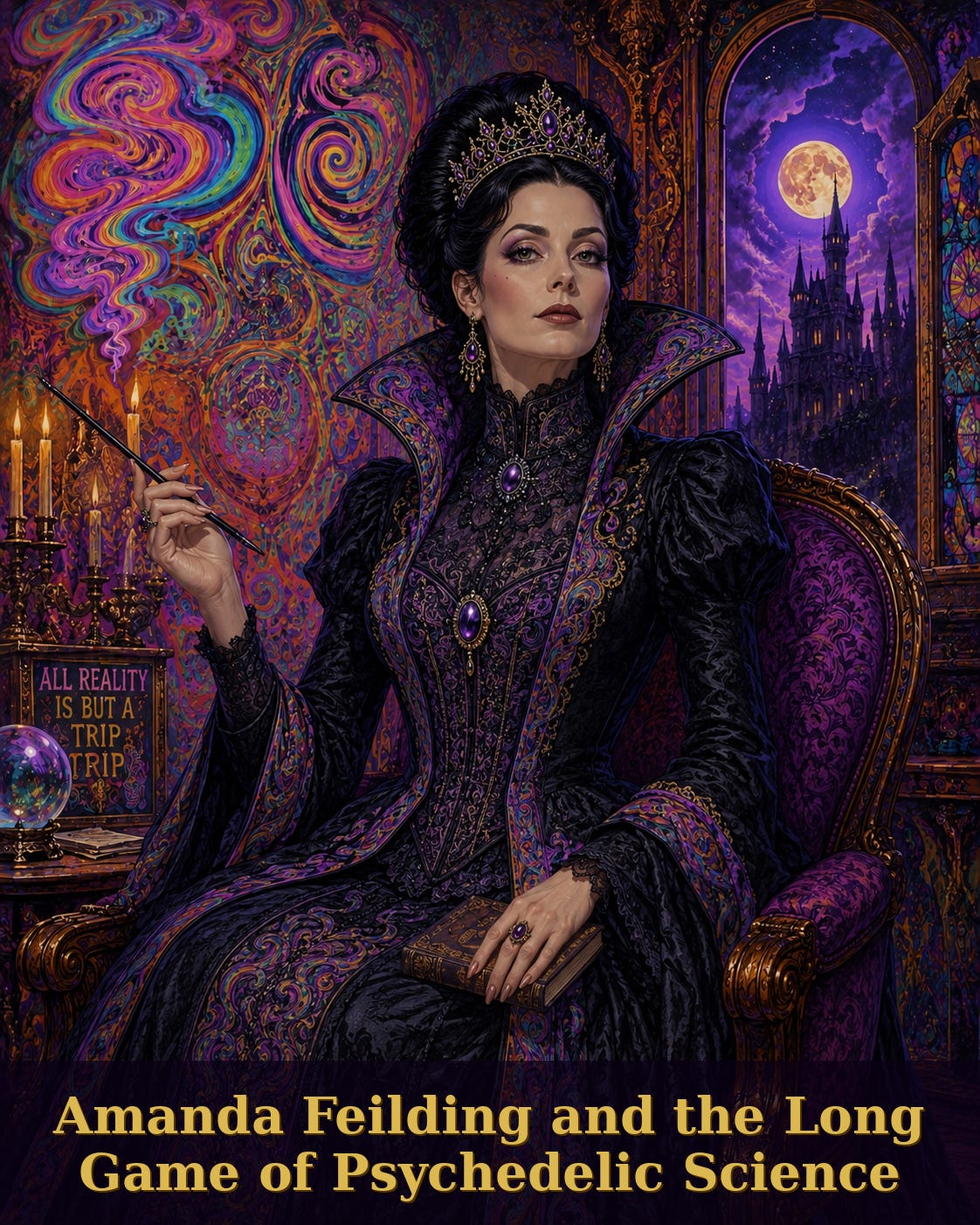
As I research psychedelic history, I keep coming back to Amanda Feilding, who died last May at Beckley Park. That was the Tudor house with three towers and three moats where she had been born eighty-two years before. She is easy to caricature and hard to dismiss, which is a rarer combination than it sounds. If she had been born centuries earlier, she would have almost certainly been burned at the stake. She was dangerous to the status quo and for that I sing her praises.
The caricature writes itself. In 1970 she drilled a hole in her own skull with a dental drill, filmed the whole thing, and titled the result Heartbeat in the Brain. She ran for Parliament twice on a single platform: trepanation for the National Health. She was an aristocrat who had been microdosing LSD since her twenties, decades before the word existed. If you wanted to discredit the entire psychedelic ecosystem, you could hardly have designed a better mascot for your opponents to point at.
A good part of the reason we take psilocybin trials seriously today traces back to this woman. She spent decades and a large share of her own fortune keeping the research alive when no respectable institution would come near it.
Her thinking started somewhere genuinely strange. Feilding believed that consciousness was, at bottom, a matter of blood. She got the idea from Bart Huges, the Dutch thinker she met in 1966, and built it into a theory: that the ego is essentially a regulatory mechanism controlling how blood is distributed in the brain, and that our sealed adult skulls limit the circulation children still enjoy. Trepanation, she argued, let the full heartbeat back in. The medical community never bought a word of it, and the evidence remains thin to nonexistent. I don’t believe it either. But it’s worth noticing that a wrong idea, held seriously, can still lead somewhere useful.
What it led to was the Beckley Foundation, which she founded in 1998, first under the earnest name Foundation to Further Consciousness. From a Tudor hunting lodge outside Oxford, she began doing the thing almost no one else would do as she partnered with actual neuroscientists, putting psychedelics into brain scanners, and publishing the results in peer-reviewed journals. The first brain-imaging study of LSD came out of that work. So did the early psilocybin-for-depression trials, co-authored with Robin Carhart-Harris and David Nutt, names that now anchor the field. She has her name on more than fifty papers. Not bad for someone with no formal scientific training and a hole in her head.
The other half of her life was politics. She understood that the science would go nowhere while the War on Drugs set the ground rules. She compiled evidence for reform and brought people together who could act on it. That included a Global Cannabis Commission, a launch at the House of Lords, and advisory roles for the governments of Guatemala and Jamaica. New Scientist called her the Queen of Consciousness, a title she seemed to enjoy. Underneath the eccentricity, she was a remarkably effective operator.
The later years complicate the picture, and I think they should. As psychedelics turned respectable, they also turned into a business, and Feilding was in the thick of it with the ventures of Beckley Psytech, Beckley Retreats, and Beckley Waves. You can read this as vindication, the long-suffering pioneer finally rewarded, or as the familiar story of a countercultural cause being absorbed into the market it once defied. Probably it’s both. I don’t think Feilding lost much sleep over the tension. She wanted the medicines legal and available, and she was pragmatic about how that happens.
What stays with me is her persistence. It is one thing to hold a strange conviction in your twenties. It is another to still be pushing it, refined and funded and half-vindicated, into your eighties, working out of the house you were born in until the year you died there. She was told for most of her life that she was a crank, and she outlasted the verdict. The research she seeded is now mainstream enough that people forget where it came from.
I don’t share all her beliefs. I’m not sure anyone should. But the field she helped build is real, and it exists in part because one persistent woman who refused to be laughed off.
Sail on Amanda Feilding. Sail off into the wild blue yonder. We were lucky to have you as long as we did.