
Ronald Stark
The Ghost Who Dosed the World

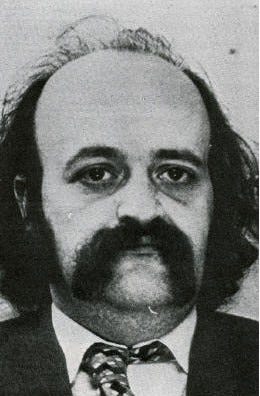
In the crowded mythology of the psychedelic underground, Ronald Hadley Stark stands apart. Not because he wrote a manifesto or gave a famous lecture or got himself arrested on the evening news. He stands apart because nobody could quite figure out who he was working for. That question, who did Stark really work for, has never been answered.
The DEA estimated Stark produced and moved fifty million doses of LSD during his years of operation in Europe. He accomplished this by embedding himself with the Brotherhood of Eternal Love, the California collective of psychedelic idealists who had decided their spiritual mission was to flood the world with acid. They had vision and Stark had the chemistry and, more importantly, the money. He arrived with resources that nobody could account for and knowledge of clandestine synthesis that went well beyond what any amateur chemist should have possessed.
He set up a laboratory in a French chateau and later moved the operation to Belgium. The product was exceptional in quality and staggering in quantity. The Brotherhood thought they had found their angel investor. Maybe they had. The question is, who the angel was actually working for?
Stark was multilingual, charming, and utterly comfortable lying to your face. He told different people different things about where he came from, who he was, and what he wanted. He moved across international borders with a fluency that struck people around him as strange. In that era, crossing borders was not always easy, particularly for Americans trafficking in controlled substances. Stark seemed to have no trouble.
He was involved in helping break Timothy Leary out of a California prison in 1970 and his subsequent exile in Algeria. That operation required money, coordination, and connections that a freelance chemist would not ordinarily possess. Stark possessed them.
He also turned up in proximity to the Palestinian liberation movement, Italian far-left terrorist networks, and various European radical organizations. Whether he was infiltrating them, supplying them, or simply running in those circles for reasons of his own, no one has been able to establish with certainty. What is certain is that a man whose day job was manufacturing LSD had no obvious reason to be anywhere near those groups.
In 1978, Stark was sitting in an Italian prison on drug charges. The presiding judge, Flavio Castellano, reviewed the case and reached a conclusion that does not appear often in legal history. He determined that Stark’s profile, his resources, his contacts, and his patterns of movement, were consistent with those of a CIA operative. Judge Castellano ordered him released on that basis. His reasoning, in plain terms, was that Stark’s real employer was the United States government.
The broader context makes this worth taking seriously rather than dismissing. By the mid-1970s, the Church Committee hearings had pulled back the curtain on MKULTRA, the CIA program that had spent years dosing unwitting subjects with LSD in pursuit of mind control. The agency’s deep and documented interest in the drug as a tool of manipulation was no longer speculative. It was on the record.
Whether that interest extended to weaponizing the counterculture itself by flooding political movements with a substance that made organized resistance difficult, gathering intelligence inside radical communities, or simply studying the social effects of mass psychedelic use is a question that remains open. The documents that might answer it conclusively have not surfaced.
Stark died in Bologna in 1984. He was 45 years old. The official cause was a heart attack. He had been released from Italian custody not long before. He left no memoir and no known family came forward. The historical record he left behind is a tangle of aliases, contradictions, and deliberate misdirection. Researchers who have tried to trace his origins have run into walls. That is either very bad luck or very good tradecraft.
The history of the psychedelic movement is usually written from the top down. We know the philosophers and the chemists who became celebrities and the cultural figures who landed on magazine covers. Stark is a reminder that the story has an underside that is considerably stranger.
If Stark was simply a true believer with exceptional chemistry skills and a gift for self-promotion, his story is remarkable enough. Fifty million doses is fifty million doses. That alone reshaped a generation. But if an Italian judge’s assessment was correct, if Stark was an intelligence asset operating inside the Brotherhood and the broader psychedelic underground, then what we call the counterculture looks somewhat different. It means the surveillance state was not merely watching from the outside. It may have had a hand in the supply chain.
That possibility has never been proven. It has also never been ruled out. Ronald Stark died before anyone could make him answer for it, which is either a coincidence or it isn’t.
If you have a line on who Stark really was, I would very much like to hear from you.
You need to read y my book Psychedelic Tricksters; A True Secret History of LSD
We need more research on Stark!