
Psychedelic Dieta
The Work Before the Work

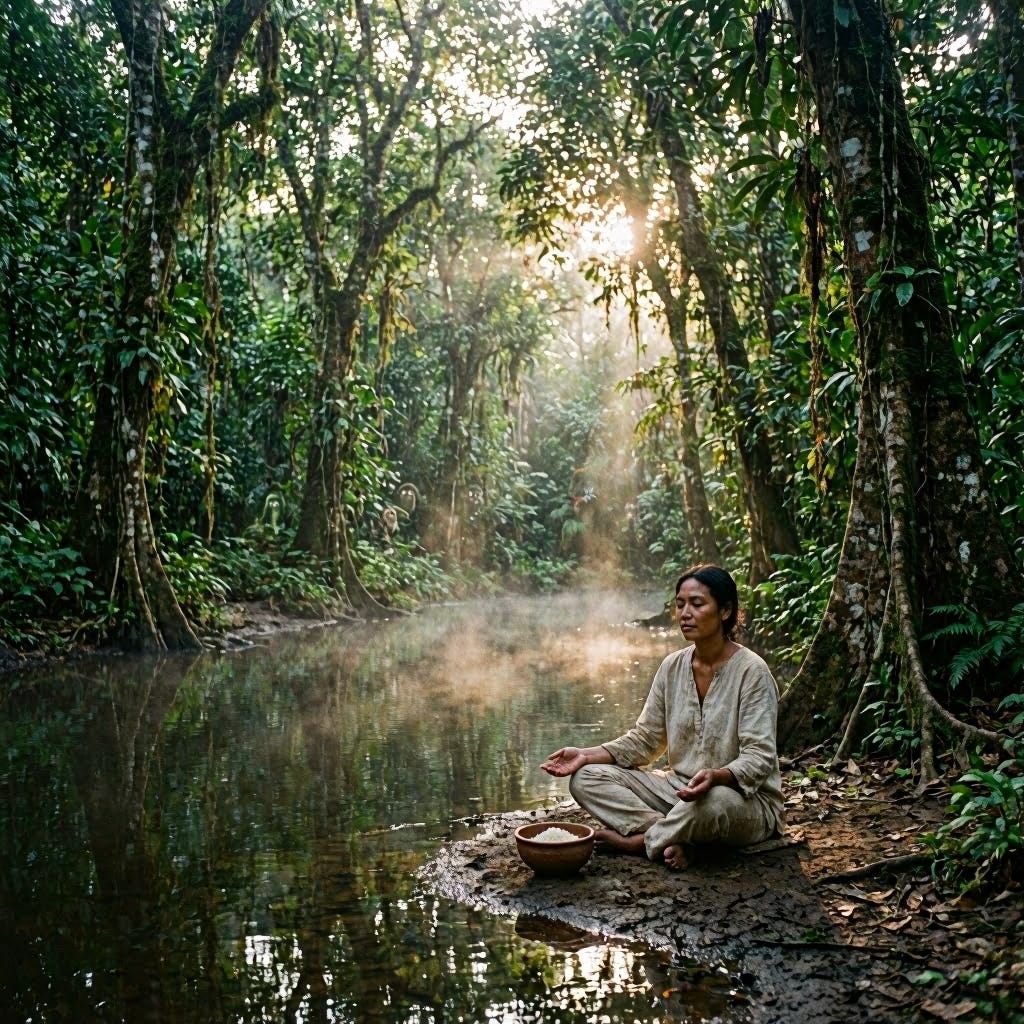
In psychedelics circles the term ‘dieta” is often referenced but rarely understood. It is not a diet understood in the classical American manner. The word comes from the Spanish, but the practice is older than Spanish colonization of the Amazon and older than anyone in the tradition can reliably date. It is, at its core, a protocol for making yourself available to a plant. And in the traditions that birthed it, that is not a metaphor.
Among the Shipibo-Conibo people of the Peruvian Amazon, one of the traditions most closely associated with ayahuasca and plant medicine, the dieta is the foundational training of a healer. An apprentice curandero who wants to work with a particular plant doesn’t just take it a few times and call themself a shaman. They enter into a relationship with it. The dieta is what that relationship looks like from the outside. From the inside, it’s something else entirely.
Here is what it involves. The apprentice retreats to an isolated space, often traditionally a small hut at the forest’s edge, away from the community. For a prescribed period, which can range from a week to several years depending on the plant and the tradition, they follow a strict set of restrictions. No salt, sugar, or alcohol. No pork or other fatty meats. No sexual contact and some traditions even restrict physical contact with others and often no social interaction beyond what’s necessary. The diet itself is bland almost to the point of punishment. The specifics vary by lineage and plant, but the principle is consistent with the goal to remove everything that might obscure the signal.
That brings us to the question of the signal. That’s the part that takes some sitting with. Within the Amazonian cosmological framework, plants are not passive organisms. They are beings with intelligence, personality, and the capacity to transmit knowledge. The Shipibo call these teacher plants “maestros,” and they take the designation seriously. Ayahuasca is the most famous but the canon of plant teachers is long. Each dieta is tailored to the plant being worked with, and each plant has its own demands.
The logic of the restrictions, once you understand the framework, is not arbitrary. Salt and sugar are believed to interfere with the subtle energetic processes the plant initiates. Sexual energy, in many Amazonian traditions, is considered a powerful force that competes with or contaminates the spiritual work. Social contact disperses the concentrated interiority the apprentice is trying to cultivate. A space is being built within the apprentice who then waits to see what comes to fill it.
What often comes, practitioners report, are visions, songs, and direct transmissions of knowledge. The icaros, the healing songs at the heart of Shipibo ceremonial practice, are not composed. They are received. A healer who has dieted deeply with a plant can call that plant’s spirit into a ceremony through its song. The song is the relationship made audible. This is not poetic language among the people who practice it. It is a technical description of how the tradition works.
Breaking the dieta is not a minor infraction. In traditional contexts, it is considered genuinely dangerous not in a vague karmic sense but in the specific sense of causing illness. The Shipibo concept of “saladera”, a kind of spiritual contamination that manifests as chronic bad luck and physical malaise, is one of the described consequences. More serious violations, particularly involving sex during a dieta with a powerful plant, are said to cause psychological destabilization that can be difficult to reverse. Whether you frame this in terms of spirits or in terms of the neurological effects of combining intense plant medicine work with boundary violations, the warning is consistent across traditions. The message is clear that the integrity of the container matters.
Here’s where things get complicated. The global explosion of ayahuasca retreats over the past two decades has brought the concept of the dieta into contact with an audience that has almost no cultural scaffolding for it. Most retreat centers in Peru, Ecuador, and Colombia ask participants to observe a pre-ceremony dieta in the days or weeks before drinking ayahuasca. No pork, no alcohol, no recreational drugs. Sometimes no sex. The reasoning offered varies and some centers frame it in the traditional spirit-relationship terms, others in more Western language about serotonin interactions and MAOI contraindications. The two explanations sit in an uneasy coexistence.
More serious practitioners, those pursuing extended apprenticeships rather than a weekend retreat, often commit to long-form dietas lasting months. Some Western students of Amazonian plant medicine have spent years in isolation, working through the full curriculum of plant teachers under a master curandero’s guidance. The accounts they return with are not easily categorized. They describe personalities in the plants, lessons received in dreams, voices that came unbidden and left them changed. You can call that psychology, you can call it neurochemistry, you can call it the spirits of the forest. The tradition predates all three frameworks, and it doesn’t need our permission to keep working.
What the dieta represents, at its simplest, is an act of respect. A relationship is being entered with something that the tradition regards as powerful, intelligent, and deserving of full attention. The restrictions are not punishment. They are preparation. They are the work done before the work begins. In a culture saturated with stimulation, noise, and the compulsive need to consume everything immediately, the dieta asks you to do the opposite and to subtract, to slow, to wait. The plants, according to the people who have worked with them for centuries, will meet you there.