
Hiding in Plain Sight
The world’s most potent naturally occurring hallucinogen

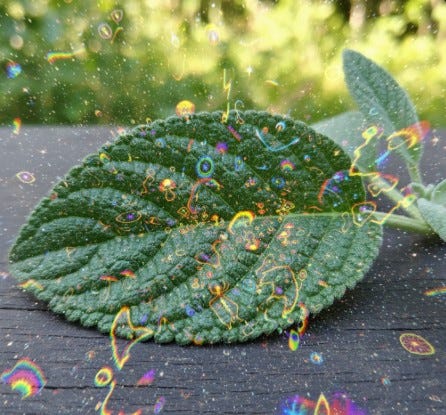
Salvia divinorum is a stepchild in the broad spectrum of psychedelic compounds and hides in the shadows of the culture. Though many have heard of it, fewer have experienced its potential. It is a tale of research never published and YouTube videos displaying teenagers taking massive doses. Those with deep knowledge are few and far between. Smoked in concentrated form the effects can begin in 15 seconds and launch the individual into an alternative universe of consciousness. However, many believe that the true value may be found in less dramatic encounters with what they call the “spirit of salvia.” Their belief is that salvia’s knowledge is behind a shroud of timidity and best approached on tiptoe with lower doses.
Unknown origin
Salvia divinorum is a mysterious and potent psychoactive plant native to the cloud forests of the Sierra Mazateca region in Oaxaca, Mexico. Some ethnobotanists speculate that Salvia divinorum may be a cultigen, a domesticated plant that does not grow wild, which suggests its use by humans could be much older than documented, but there is no convincing evidence to confirm this. Botanists have not determined whether Salvia divinorum is a cultigen or a hybrid, as native plants reproduce vegetatively and rarely produce viable seeds. This unusual propagation method adds to the mystery of its origins, as it is unclear how the plant spread and became established in the region. The plant’s lack of wild populations and reliance on vegetative propagation suggest it may have been cultivated by Indigenous peoples for generations, but the timeline and circumstances of its domestication are lost to history. The species name “divinorum” means “of the diviners,” reflecting its role in Indigenous Mazatec shamanic practices. While there are over 900 species in the Salvia genus, Salvia divinorum stands apart for its unique psychoactive effects.
Chemical Properties
Salvinorin A is the principal psychoactive ingredient in Salvia divinorum. It is structurally unique among hallucinogens because it does not contain nitrogen and is not an alkaloid. The active compound of the plant, Salvinorin A, is a potent and selective kappa opioid receptor (KOR) agonist. This is unusual, as most hallucinogens act on serotonin receptors, but salvinorin A does not activate the serotonin 2A receptor. In this regard it mimics the receptor pathways of ibogaine.
Legal Status
Surprisingly, Salvia divinorum and its active compound, Salvinorin A, are not classified as controlled substances under federal law and have not been placed in the Controlled Substances Act schedules. Though not federally banned, legal status is determined by individual states with wide variations.
Research and Future Directions
Scientific interest in Salvia divinorum is growing, particularly in the fields of neuropharmacology and psychiatry. Researchers are investigating how Salvinorin A interacts with the brain’s opioid system and exploring its potential to treat mood disorders, chronic pain, and substance dependence. Some studies suggest that kappa-opioid agonists like salvinorin A could offer new pathways for managing depression or addiction, though much remains unknown.
Resources
Compared to other psychedelics, there is a dearth of reliable information on Salvia. You can find reliable information at the links below:
On Erowid at: https://www.erowid.org/plants/salvia/salvia.shtml.
Christopher Solomon is an advocate for the mindful use of Salvia:
Peter Addy performed extensive research and interviews with him are available: https://peterhaddy.com/category/podcast/
This is such a clear, grounded look at a plant most people only know through sensationalized stories. I really appreciate the way you highlight Salvia’s mystery, its unique pharmacology, and the quiet wisdom people find in lower-dose experiences. Thank you for giving this overlooked plant the thoughtful attention it deserves.