

In the summer of 1955 a New York banker climbed into the mountains of Oaxaca and sat through an all-night mushroom ceremony led by the Mazatec healer María Sabina. Two years later he told the story to the readers of Life magazine. Within a decade her village, Huautla de Jiménez, was crowded with foreign seekers, researchers, and eventually police. Late in her life Sabina said the mushrooms had lost their power for her. Outsiders had taken them for pleasure, and she believed that had spoiled something that was meant for healing.
The banker was R. Gordon Wasson, and his article, “Seeking the Magic Mushroom,” is usually treated as the starting gun of the modern psychedelic era. I think it is more useful to read it as a turning point in the history of ritual. A ceremony built over generations to diagnose illness and find lost things was lifted out of its home and rebuilt somewhere else. That has kept happening ever since. Each time the ceremony moves, someone gains authority over it and someone loses it.
What the evidence actually shows
The story people want to tell about ancient psychedelic ritual usually begins at Eleusis, where for nearly two thousand years initiates drank the kykeon before entering the sanctuary of Demeter. In 1978 Wasson, Albert Hofmann, and Carl Ruck argued that the drink contained ergot alkaloids, something close to a natural cousin of LSD. It is a serious hypothesis from serious people, and it is the reason this publication carries the name it does. But it remains a hypothesis. No chemical residue from the Eleusinian rites has confirmed it, and more recent popular books have stretched the argument well past what the evidence supports.
The harder evidence comes from elsewhere. In 2005 a team analyzed two peyote buttons recovered from a cave on the Rio Grande in southwest Texas. Radiocarbon dating placed them around 3700 BCE, and mescaline was still detectable in the samples. In 2019 researchers examined a leather ritual bundle from a rock shelter in the Bolivian Andes, about a thousand years old. They found traces of DMT, harmine, bufotenine, and cocaine. Harmine and DMT together are the chemical logic of ayahuasca. The authors were careful: the finding suggests these plants were combined in ritual use, but it cannot show exactly how, or that anyone brewed anything resembling modern ayahuasca.
So here is what we can say. Humans have used psychedelic plants in ritual settings for thousands of years. What those rituals looked like, who led them, and what participants believed they were doing is mostly lost to us.
The ceremony goes to court
In the twentieth century the ceremony had to learn to survive the law. In 1918 peyote practitioners in Oklahoma incorporated as the Native American Church, partly to gain legal standing as a religion. The all-night peyote meeting, with its fire, its drum, and its roadman, took on officers and bylaws and a blend of Indigenous and Christian practice.
That protection had limits. In Employment Division v. Smith (1990), the Supreme Court ruled against Alfred Smith, a Klamath man fired from his job as a drug counselor after taking peyote at a church ceremony and then denied unemployment benefits. The Court held that a neutral, generally applicable law did not have to make room for religious practice. Congress responded with the Religious Freedom Restoration Act in 1993 and, in 1994, amendments to the American Indian Religious Freedom Act protecting peyote use by members of federally recognized tribes.
Ayahuasca followed a similar path. In Brazil, the Santo Daime (founded in the 1930s) and the União do Vegetal (founded in 1961) wrapped an Amazonian brew in hymns, uniforms, and doctrine. When federal agents seized the UDV’s tea in New Mexico, the case went to the Supreme Court, which ruled unanimously for the church in 2006. The oral argument transcript is worth reading. You can hear the justices of the highest court in the land working through the pharmacology of a tea.
The ceremony goes to the lab
Meanwhile the laboratory was building its own ritual and calling it something else. In 1963 Timothy Leary, George Litwin, and Ralph Metzner published a study arguing that reactions to psilocybin depended heavily on expectation and environment. The phrase “set and setting” entered the vocabulary. A year earlier, Walter Pahnke’s Good Friday Experiment gave psilocybin to divinity students during a service at Boston University’s Marsh Chapel. Rick Doblin’s follow-up about 25 years later found that many participants still valued the experience, but also that the original report had left out a significant event. One student became so agitated he fled the chapel convinced that he was chosen to announce the return of the Messiah. He was physically restrained, returned to the Chapel, and given an injection of Thorazine.
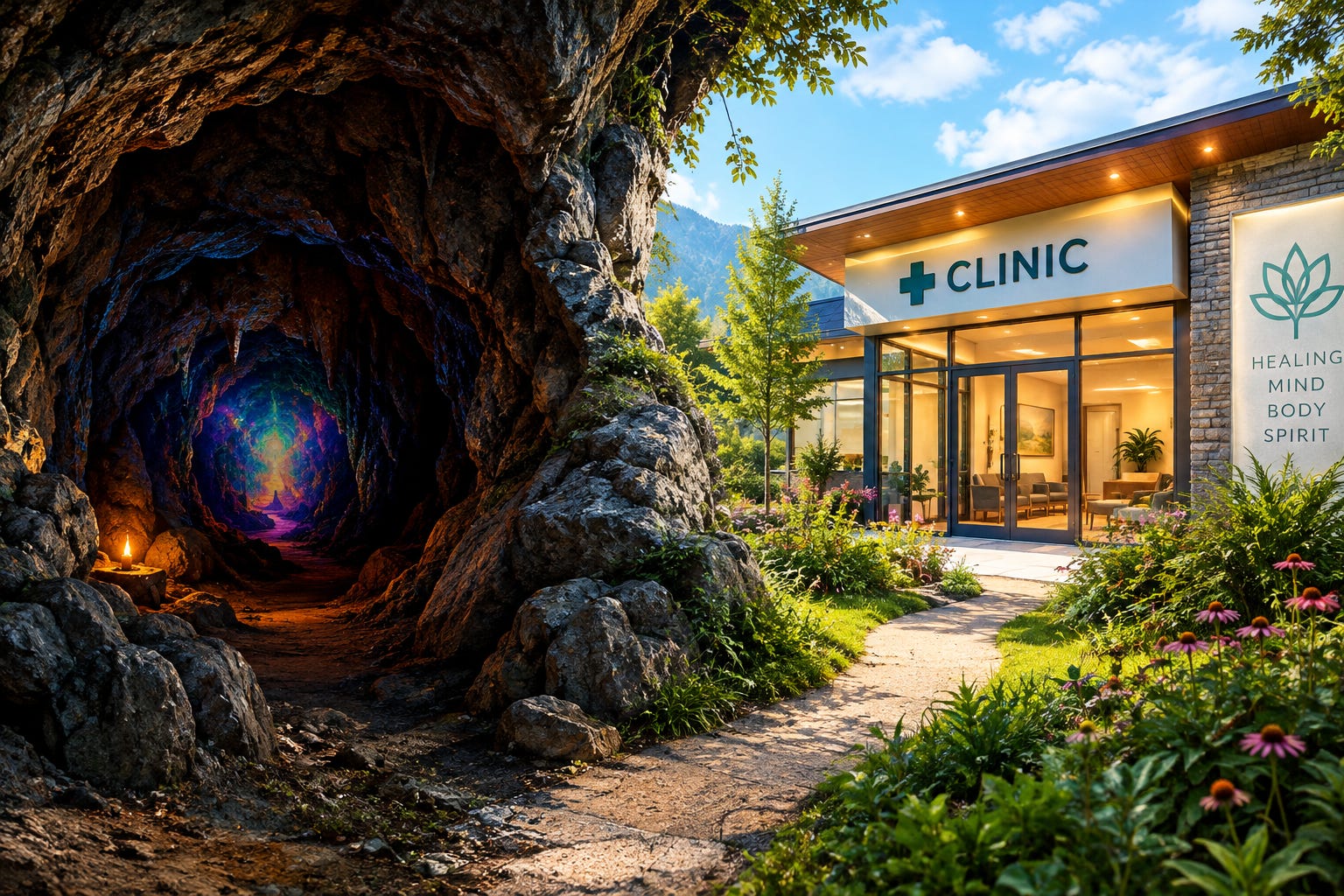
Today’s clinical trials follow published safety guidelines: a room furnished like a living room, eyeshades, a curated playlist, two trained monitors, preparation sessions before and integration sessions after. Strip away the scientific language and that is a ceremony, with a secular priesthood and a liturgy of music.
This is where I want to be careful. If the container is part of the treatment, it becomes very hard to know how much of the benefit comes from the molecule. A 2021 review by Suresh Muthukumaraswamy and colleagues pointed out that participants in psychedelic trials can usually tell whether they got the drug, which means expectancy effects are difficult to separate from pharmacology. That is not a dismissal of the research. It is a statement about what has and has not been shown.
The ceremony goes to market
The newest shape is commercial. Oregon voters approved Measure 109 in 2020, and licensed psilocybin service centers began operating in 2023, with trained facilitators and no medical diagnosis required. Colorado followed with its own framework in 2022. Abroad, retreat centers sell ceremony packages in tiers, with the shaman listed among the amenities.
None of this is automatically bad. Legal frameworks can bring training, screening, and accountability to practices that once had none. But the pattern since 1955 is consistent. The ceremony moves, and the people who carried it for generations are rarely the ones who profit when it arrives.
María Sabina did not write articles or testify before courts. She left us her chants, a few interviews, and a warning that something sacred can be used up. Every new version of the psychedelic ceremony, whether in a church, a clinic, or a licensed service center, should be asked the same question: who is holding this and whom does it serve?
AI disclosure: AI (Claude Cowork) was used to facilitate access to research and scientific data, assist with drafting and organizing text, and provide error checking. The author generated the underlying intellectual ideas and research questions, interpreted the scientific literature, formulated the essay’s conclusions, verified all sources, and made all other decisions about intellectual content.
I really appreciate this essay and the reminder of how important the ceremony is- even if it is not set as intentionally as it once was...it's still there, even if intuitively set up that way. I've offered group ceremonies, too, and have found my own challenges with them, specifically transference and counter-transference. Thank you for highlighting the sacredness and importance of ceremony and for those we honor whose footsteps created the framework for us.
Excellent info - I live in San Miguel de Allende and have been holding retreats for six years here. This is a huge subject for us who do not follow the pharmaceutical ploy --