
Elders at the Threshold: Psychedelics for Seniors
A Message to My Generation

The turbulence of the 1960s hit like a hurricane, and nothing stayed tidy after that. Cities burned and our leaders were shot down in waves of violence. The counterculture rose from the ashes. In 1967, during the Summer of Love, I first encountered the immense and humbling power of psychedelics. I have been thinking about them ever since.
What I could not have predicted was that the people with the most to gain from these medicines might turn out to be people of my own current age of 75. I’m speaking directly to those seniors navigating the accumulated weight of decades, the slow losses that come with later life, and a medical system that too often has nothing left to offer except another pill.
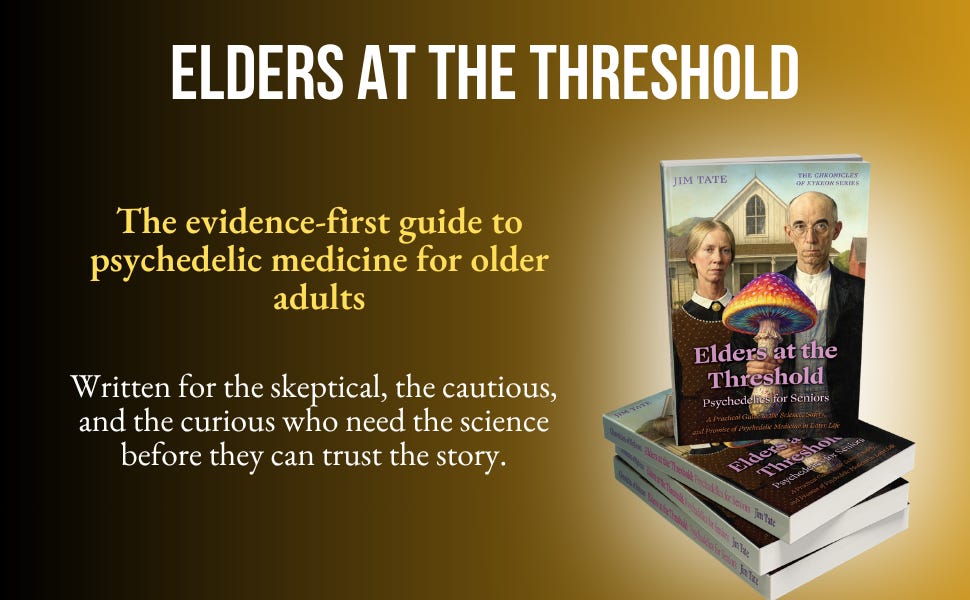
I wrote Elders at the Threshold: Psychedelics for Seniors for my generation. This book is for them. It is also for their children, their doctors, and anyone else willing to look past the mythology and examine what the science actually says. The evidence is serious. The research is real. And the conversation, for far too long, has excluded the very people who perhaps need it most.
The burden of psychiatric illness among older adults is vast, undertreated, and badly in need of better tools. Depression affects an estimated fifteen to twenty percent of adults over sixty-five. Anxiety disorders are even more prevalent. PTSD among veterans and trauma survivors is chronically underdiagnosed in older populations. The available treatments, primarily antidepressants and conventional talk therapy, leave a large proportion of patients without adequate relief. Psychedelic-assisted therapy is emerging as the most promising response to this gap.
We are at the beginning of something. The scientific renaissance in psychedelic research is barely twenty years old. The first legal supervised psilocybin services in the United States have been operating for just over two years. The clinical trials most directly relevant to older adults for Alzheimer’s disease, age-related cognitive decline, chronic pain, and late-life depression and anxiety are mostly still in early phases. The regulatory and healthcare systems that will ultimately determine how these treatments are delivered and who can access them are still being built. We are in the early pages of a story whose later chapters have not yet been written. What can be said with confidence is that the direction is clear. The scientific momentum is real, and the human need driving it is profound.
An aging population is struggling under a burden of mental and existential suffering that conventional medicine addresses only partially and inadequately. Some members of my generation have begun to find something that was missing: not symptom management, but the possibility of genuine transformation. The promise of meeting the final years of life with less fear, less isolation, less unprocessed grief, and more capacity for presence is real.
60s survivors may be interested in an essay we believe was written by Chester Anderson, in 1968: "What is the Psychedelic Revolution?"
https://drive.proton.me/urls/XHGZPVM7WR#fN9TMrJg4ehu
Perhaps also this complete version of the Port Huron Statement
https://drive.proton.me/urls/3VR2DMK1E8#VXkFdcvmcVti